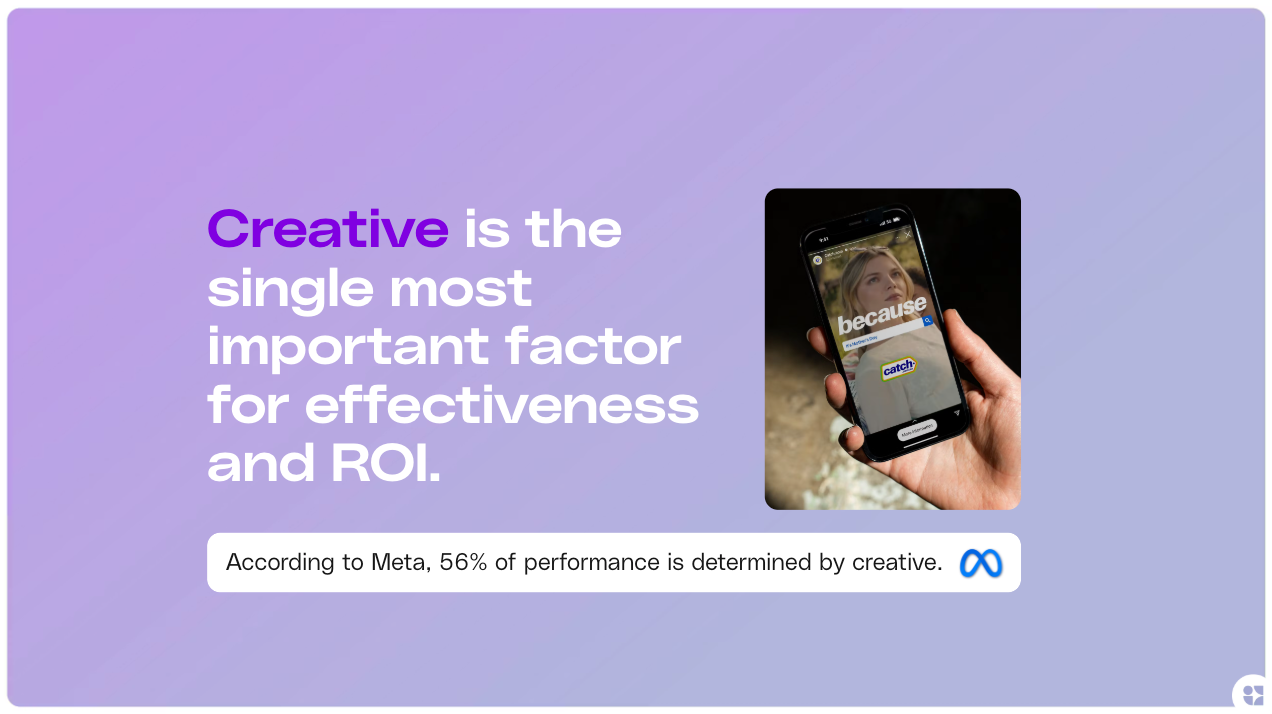
Cuttable exists to solve one specific problem modern performance teams can’t ignore anymore: creative has become the primary growth constraint.
We work with performance-led ecommerce brands spending $30k–$250k per month on Meta who already understand the basics — and are still plateauing. Not because they’re bad at media buying, but because their teams aren’t built to produce creative at the speed the platform now demands.
This article explains why that happens — and why the teams that win have stopped treating creative as an output, and started treating it as infrastructure.
The narrative around Meta ads hasn’t caught up to reality.
Most performance teams still operate as if 2019 targeting mechanics are alive and well. They spend hours obsessing over audience segmentation, testing bid strategies, debating campaign structures. They hire consultants to audit their account setup. They read case studies about brands that “cracked the algorithm.”
And then they plateau anyway.
Here’s what’s actually happening: your performance ceiling is a creative supply problem, not a media buying problem.
The Old Mental Model Is Broken
For years, the performance marketing playbook was clear. Find your audience. Optimise your funnel. Scale what works. Targeting was precise, attribution was clean, and incrementality compounded predictably.
That world is gone.
Apple’s ATT update didn’t just reduce signal — it fundamentally shifted where leverage lives in the system. Meta’s Advantage+ suite didn’t give you better tools for precision. It removed precision as a meaningful variable entirely. The platform now handles targeting, placement, and bidding with minimal input from you.
What remains as your controllable input? The ads themselves.
Yet most teams are still organised around optimisation theatre. They’re tuning dials that barely move the needle while starving the system of the one thing it actually needs: variation.
Why Ads Stop Working
When a campaign “fatigues,” the diagnosis is almost always wrong.
Teams see frequency climb and CTR drop and conclude the creative is burned out. So they pause it, go back to the design team, and wait weeks for a “fresh concept.”
But frequency rises because the system has nothing new to show. It’s not that your audience is tired of your ad. It’s that Meta’s delivery algorithm is desperate for new inputs — and you’re not providing them.
Think of it this way: Meta’s system is designed to find incremental performance across millions of micro-variations in delivery. It tests your ad against every possible combination of user, context, and competitive environment. When it exhausts the high-probability matches, performance decays — not because your creative failed, but because the system ran out of places to efficiently show it.
The solution isn’t to create one “better” ad.
It’s to create continuous variation so the algorithm never runs out of options.
Why Volume Doesn’t Mean Low Quality
The instinctive pushback here is obvious:
“If we produce more, quality will suffer.”
This assumes volume and quality are inversely correlated. They’re not.
The teams producing the most creative aren’t lowering their standards. They’re changing what they optimise for. Instead of obsessing over every pixel in a single hero asset, they’re building systems that generate useful variation quickly.
They’ve accepted that most ads won’t be breakouts — and that’s fine. Because in an always-on testing environment, the goal isn’t to produce one perfect ad. It’s to produce enough signal-generating inputs that the platform can find what works right now, in this context, for these users.
High-velocity creative teams don’t chase polish.
They chase learning speed.
Creative as Infrastructure
The mindset shift required here is significant.
Most teams treat ads as precious assets. They workshop them. They approve them in rounds. They launch them with fanfare. This made sense when creative was expensive to produce and media was cheap to test.
Now the economics are reversed.
Media is expensive.
Creative should be abundant.
The highest-performing teams have stopped thinking about ads as campaigns and started thinking about them as infrastructure.
They build libraries of modular components — hooks, body copy variations, CTAs, visual styles — and recombine them rapidly. They don’t ask, “Is this good enough to run?” They ask, “Will this generate useful signal?”
This doesn’t mean sloppy execution.
It means ruthless prioritisation of what actually moves performance: testable variation, not theoretical perfection.
What High-Performing Teams Do Differently
If you audited the top 10% of performance teams on Meta today, you’d find a consistent pattern.
They produce creative weekly, not monthly.
They think in components, not concepts.
They treat testing as a continuous discipline, not a campaign phase.
Their designers aren’t bottlenecked by approval workflows.
Their ops teams aren’t waiting on agencies.
They’ve built internal systems that allow rapid iteration without sacrificing brand coherence.
And critically, they’ve stopped hunting for the “one winning ad.”
They know breakout performance is an emergent property of volume and variation — not a reward for finding the perfect idea.
They’ve accepted that in a post-targeting world, creative is the primary growth lever.
Everything else is overhead.
What This Means for You
If you’re spending $50k, $100k, or $250k per month on Meta and your performance has plateaued, the problem is almost certainly upstream of your media strategy.
You don’t need a better agency.
You don’t need a more sophisticated attribution model.
You don’t need another audit of your campaign structure.
You need more ads.
Not more of the same ad.
More variation.
More inputs.
More signal for the system to optimise against.
The question isn’t whether this is true — the data is overwhelming.
The question is whether your organisation is designed to produce creative at the speed modern performance requires.
Because the teams that figure this out aren’t just outperforming their competitors.
They’re playing a completely different game.
What Cuttable Changes
Everything above is true whether Cuttable exists or not.
But it leads to a practical question most serious teams eventually hit:
If creative volume is the lever — how do we actually build this into our workflow without burning out our team or endlessly adding headcount?
That’s the gap Cuttable was built to fill.
Cuttable is a creative production system installed into your existing performance team. It helps you scale creative velocity without scaling people — by turning your existing assets, brand knowledge, and performance data into continuous, testable variation.
Not by replacing your creatives.
Not by generating random ads.
But by giving performance teams the infrastructure to produce, test, and iterate creative at the pace Meta now demands.
If this article reflects what you’re experiencing — stalled performance despite strong fundamentals — it’s usually worth a conversation.
👉 Book a demo to see how high-velocity teams are removing creative as a growth constraint.